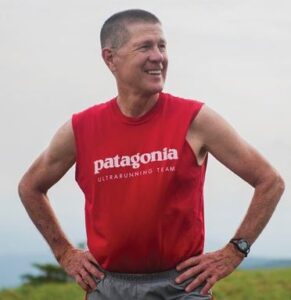
 David Horton, of Lynchburg, Virginia, can be called the professor of ultrarunning. He has contributed to the sport in so many ways: as an elite road runner, elite mountain trail runner, FKT holder of extremely long trails, model race director, and above all, an inspirational and driven teacher that has brought many hundreds of young people into the sport. He has finished more than 160 ultras and won at least 40 of them. He was the second of only 20 people who have finished the Barkley Marathons and once held the fastest-known-times for the Appalachian Trail, Pacific Crest Trail, and the Long Trail in Vermont.
David started running as a college freshman in 1968 when he was invited to join the track team. He finished his first mile race in 4:59. But he did not start running long distance seriously until 1977, at age 27, when he was working on his doctorate in education at the University of Arkansas. His first marathon finish time was 3:23:54.
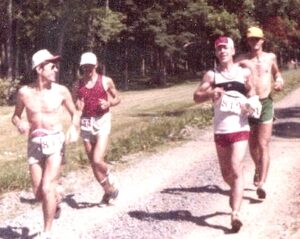
In 1978, David moved to Virginia to teach at Liberty University in Lynchburg, Virginia. In 1979, he took up ultrarunning and ran in his first ultra without even meeting an ultrarunner before. He went to run the JFK 50 in Maryland, and placed surprisingly high, in 24th place out of 400 runners. That started his very long association with that oldest ultramarathon in America. He went on to finish it 18 times, including a win in 1985 in terrible muddy conditions. He had eight podium finishes at JFK 50.
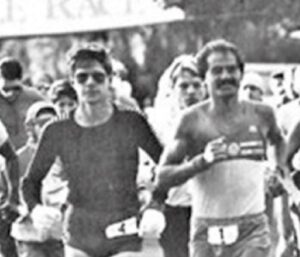
In 1983, still early in his trail running career, David ran his first Western States 100. He had trained hard for it, running about 2,000 miles since the first of the year. He finished in 9th place with a time of 18:39. In 1986, on the road, he ran an extremely fast 100-mile time of 14:26 at Flushing Meadows, coming in 3rd to Yiannis Kouros.
David truly gave back to the ultra community by putting on various difficult ultra trail races. He became the sport’s premier race director. His creations included Mountain Masochist 50 in 1983, the Holiday Lake 50K in 1996, the Promise Land 50K in 2000, and his crowning achievement race, Hellgate 100K, in 2003. The term “Horton miles” became part of the ultrarunning dictionary. He was known for putting on races that measured on the long side. He once estimated that a “Horton mile” was probably about 1.1 miles. He has directed more than 100 ultra-distance races.
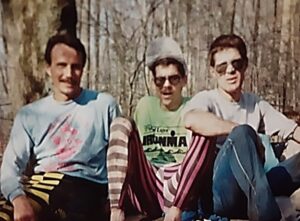
In 1990, David, fellow hall-of-famer, Eric Clifton, and David Drach finished the “fun run” of the ridiculously difficult Barkley Marathons in Tennessee. They completed the fun run in time to continue on for a fourth loop. Clifton went out to do 100 meters of loop four to claim the longest Barkley attempt ever. David was just waiting for his chance. With only seconds remaining to leave on loop 4, David went out and traveled 150 meters to snatch away the record. In 2001, David became the second person in history to finish the Barkley Marathons with a new record time of 58:21:00. He said it was the hardest race of his entire life.
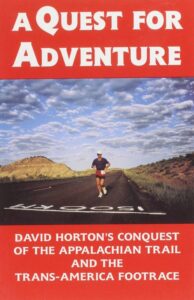 David loved to be out in the mountains doing long adventure runs and doing them fast. He said, “When I do something I have got to do it all out. I have got to do it as much as I can and be the best I can.” He turned his multi-day long run passion toward going after “fastest known times.” In 1991, David sought to set the speed record for the Appalachian Trail, 2,144 miles from Georgia to Maine. His goal was to run it in under 60 days. He would normally run for twelve hours each day and smashed the existing record by ten days, finishing in 52 days, 9 hours, and 41 minutes. In 1995, he ran across America in the Trans America Footrace, posting the third fastest time ever at that time. He later authored the book, Quest for Adventure: David Horton’s Conquest of the Appalachian Trail and Trans-American Footrace.
In 1992, the Hardrock 100 was created in Colorado. Some runners were shocked by its difficulty and danger. An Ultrarunning Magazine editorial stated, “Do it at your own risk. There is no honor in being the first to die at the Hardrock, just as there is no shame in settling for an ‘easy’ challenge such as Western States.” David won the first two years of the race and went on to finish it five times.
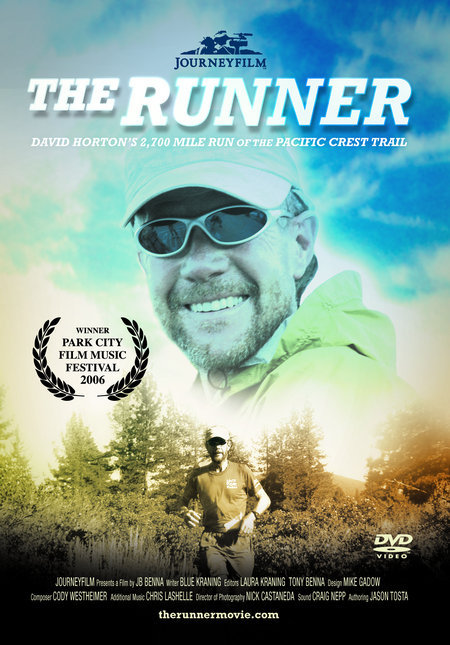
In 2006, a documentary was produced about his successful attempt to break the speed record on the Pacific Crest Trail. It is titled The Runner: Extreme Ultrarunner David Horton. He set a new record of, 66 days, 7 hours, 16 minutes. David said, “I don’t run for health or fitness. Health and fitness are by-products of what I do as a runner. As a runner I ran to compete. I ran to do well in races. I ran to achieve. I ran for a purpose. I ran to also be an example to others and to try to motivate others to move, to do things.”
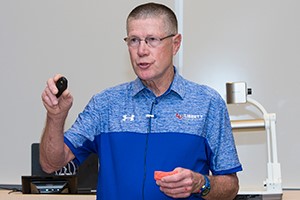 As a professor of health and sciences at Liberty University in Virginia for 46 years, Dr. Horton taught an advanced running course that helped bring hundreds of young runners into the sport. He made the course fun and interesting. It changed many lives. The students were required finish race of 50K or longer.
David has had a long-time passion in doing trail work. He has built over 50 miles of trail on Liberty Mountain, in Lynchburg, Virginia. He has also been a maintainer of three miles of the Appalachian Trail for 33 years.
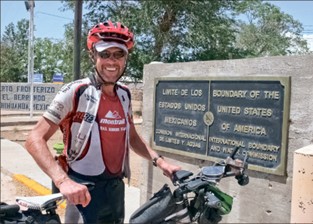 In 2010 because his right knee was now bone-on-bone, David took up long-distance biking. In 2017, he finished the 4,200-mile Trans Am Bike Race. He said, “I am continuing to stay active and compete as a biker. I am still an athlete. Don’t ever stop. Consistency is key, getting back in shape is always harder than maintaining it.” In 2012, he had heart bypass surgery, and in 2014, he had a knee replaced, which enabled him to finish an ultra in five different decades. His lifetime running miles have exceeded 113,000 miles. In 2018, a film “Extraordinary,” was produced about David’s amazing running career, his faith in God, and his family life. It was shown in hundreds of theaters across America.
David Horton continues to bike long distances and direct ultramarathons. He retired from teaching after 46 years in 2025.